Europlexus Software
-
Fast transient dynamics
-
Fluid-structure interaction
-
Multiphysics
Explore different versions or discover the Europlexus universe
EPX E&R Light
The free EPX version for academics, accessible through direct download. This version is dedicated to test and evaluation with a maximum number of 20 000 structural elements and 200 000 fluid elements.
Current version is EPX 2026.0 (built on October, 24th, 2025)
EPX E&R Full
This is the licensed EPX version for academics, with full content and features.
Current version is EPX 2026.0 (built on October, 24th, 2025)
EPX Production
This is the licensed EPX version for industrial and engineering use.
Current version is EPX 2026.0 (built on October, 24th, 2025)
The EPX Consortium

Meet the software's co-owners and major partners
Features
Models
Features an extensive palette of structural and fluid models, diverse types of elements for explicit dynamics.
Coupled dynamics
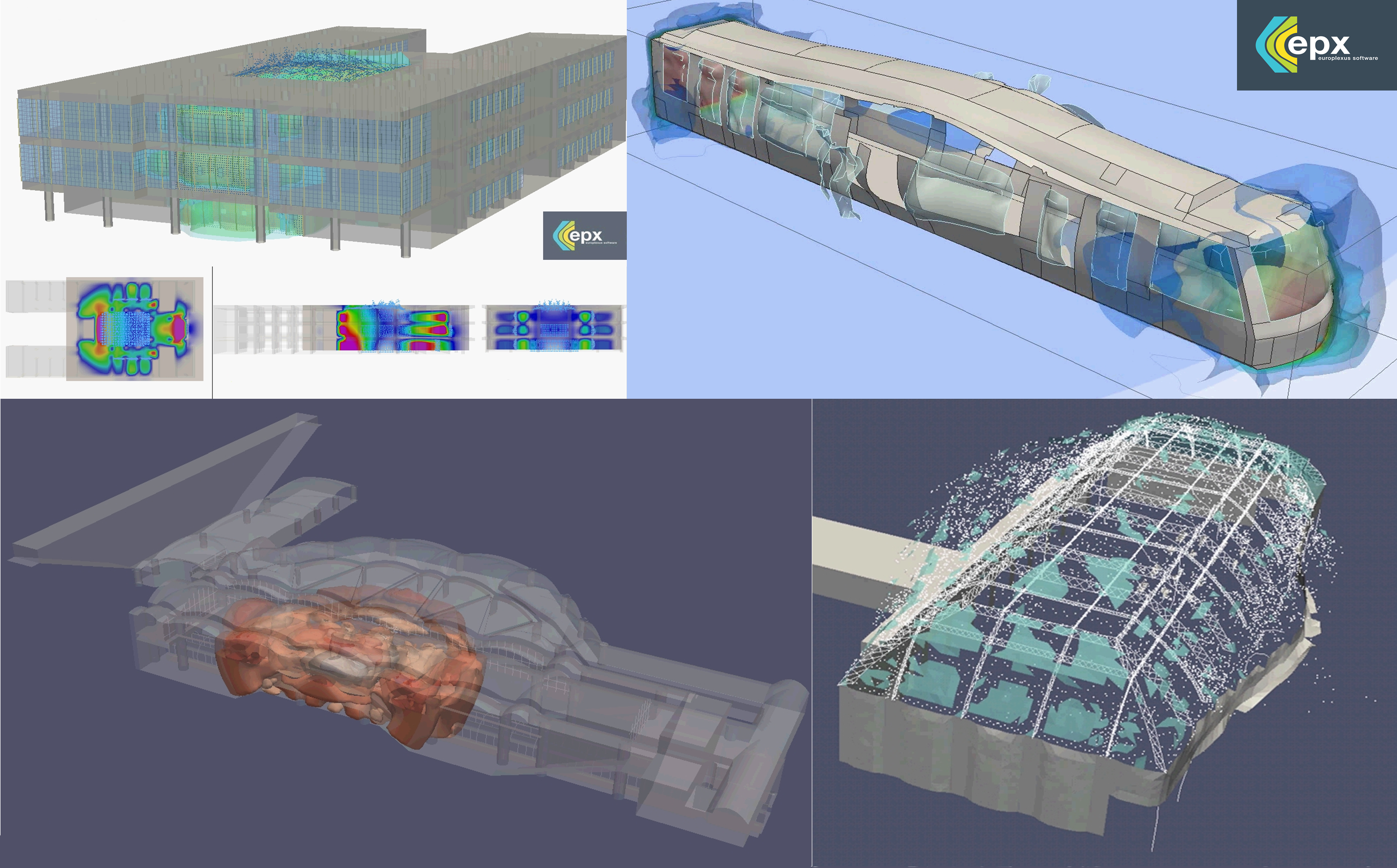
Variety of ways to couple physical entities in the calculation. Regarding Fluid-Structure Interaction, EPX includes both Arbitrary Lagrangian-Eulerian and Immersed Boundary methods.
Links
Several link possibilities for contact & constraints. Different options to solve the links, for example Lagrange Multipliers or Penalities.
Models
Features an extensive palette of structural and fluid models, diverse types of elements for explicit dynamics.
Coupled dynamics
Variety of ways to couple physical entities in the calculation. Regarding Fluid-Structure Interaction, EPX includes both Arbitrary Lagrangian-Eulerian and Immersed Boundary methods.
Links
Several link possibilities for contact & constraints. Different options to solve the links, for example Lagrange Multipliers or Penalities.
-
Non-exhaustive list of EPX structural features:
- Finite Elements: The primary discretization for structures. Europlexus offers a wide range of elements (1D, 2D, and 3D) including beams, shells, and volume elements, and supports non-linearities at both geometric and material levels.
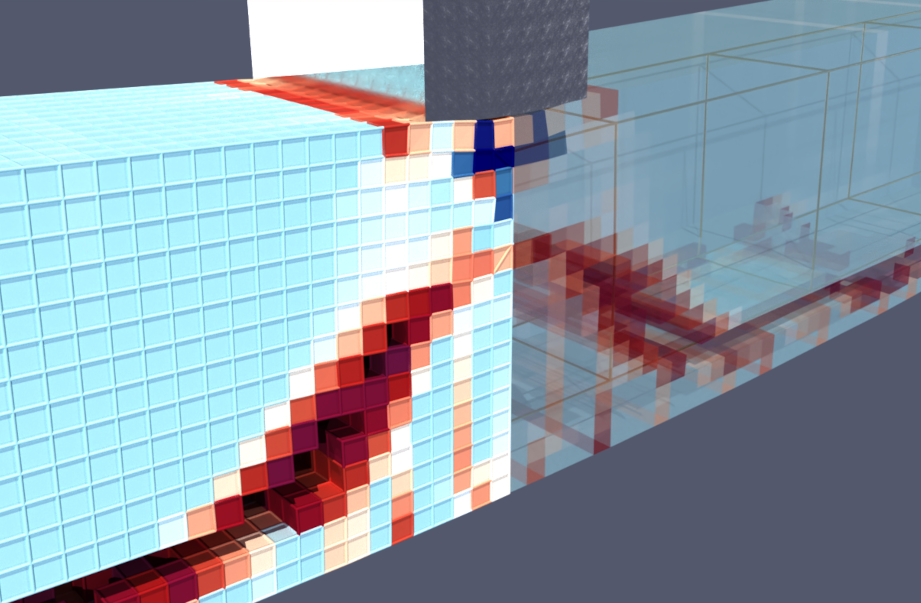
- Damage: Accounts for the progressive degradation of material stress and stiffness. The solver integrates various damage models within its constitutive laws to simulate material micro-cracking and loss of integrity under dynamic loading.
- Plasticity: A core feature for non-linear material response, essential for dynamic events like impacts and explosions. Europlexus provides a library of constitutive laws (e.g., elastic-plastic models like the von Mises yield criterion) that can include hardening, strain rate dependency, and thermal effects.
- Sliding contact: A key kinematic feature to model the interaction between separate structural parts. It supports various algorithms (like the pinball model or the slave nodes/master surfaces modelling) and can enforce constraints using both the highly accurate Lagrange Multipliers or the more robust Penalty methods.
- Erosion: A feature to handle large-scale cells removal. Erosion is activated when a predefined calculation or failure criterion is met, allowing the calculation to continue after localized cell deletion.
-
Non-exhaustive list of EPX fluid features:
- Finite Volumes: The main spatial discretization scheme (alongside Finite Elements and SPH) for the fluid domain, implemented in a Cell-Centred configuration. This method is well-suited for compressible flows involving strong shocks and discontinuities.
- Combustion: Europlexus includes specific models, such as the CDEM, to simulate reactive flows. This capability allows for the high-fidelity analysis of phenomena like blast (e.g., hydrogen blast in an enclosure) and the propagation of detonation or deflagration waves, which is critical for nuclear and industrial safety applications.
- Adaptive Mesh Refinement - AMR: A technique that automatically and dynamically refines or coarsens the computational mesh during the simulation, based on local solution features (like steep gradients, wavefronts, or error indicators). This ensures optimal resolution where it is most needed (e.g., around a propagating shock front). AMR is also available for solids.
-
Intrinsic capability of EPX for Fluid–Structure Interaction:
- Arbitrary Lagrangian-Eulerian: When used for FSI, the fluid mesh conforms to and moves with the structure's boundary. It offers high accuracy for conforming meshes. It often requires re-meshing to prevent excessive mesh distortion, especially when the structure undergoes large displacements. Best suited for problems where the fluid-structure interface remains relatively regular and displacements are not extremely violent.
- Mediating Body Method: In-house method, robust for complex geometries and scenarios involving large structural displacements, fragmentation, or contact. This makes it suitable, for instance, for blast problems where structures can break up or move through the fluid domain.
- Weak and strong coupling: Europlexus implements both strong and weak coupling approaches depending on the method (for instance, FLSR/FLSW for immersed boundary methods).
-
Europlexus for interoperability and multiphysical usage:
- Interoperability: Europlexus includes several features that facilitate interoperability. One example is the MFront format for integrating external material constitutive laws, along with the MGIS interface.
- External and partitioned coupling: Europlexus can be used as an external fast transient explicit solver using a dedicated interface like ICoCo. This is useful for explicit/implicit and partitioned multiphysical coupling.
- MED format: MED is a standard format used by CEA and EDF simulation tools. This format makes data exchange easier.
- Coupling interface framework: Europlexus has its own internal FSI frameworks for both ALE and immersed boundary methods. For multi-code coupling, Europlexus's adherence to standards like MED and ICoCo allows it to integrate with external, dedicated coupling libraries that manage the coupling algorithm, the transfer and interpolation of data.
-
Some EPX features are used for the simulation of pipeline systems:
- 2D/3D finite volumes: Used to discretize fluid domains in Eulerian or Arbitrary Lagrangian-Eulerian (ALE) descriptions.
- 1D variable cross-section elements: 1D beam or pipe elements are often used to model structures like pipelines. This formulation, often coupled with a 1D fluid model, accounts for transient structural dynamics while efficiently including pipe cross-section variations along its length.
- 1D/3D coupling elements: A capability that allows the efficient simulation of extensive systems like pipe circuits. Europlexus can couple a 1D model (for computational efficiency in long straight runs) with a 3D model (to capture localized phenomena).
- Flexible pipes: Europlexus includes models designed to simulate the dynamic behavior of pipelines, which inherently includes flexibility. This is useful for assessing the response of pipes to internal fluid transients (like water hammer) or external loads.
Simulation Environment & Workflow
EPX can import mesh files from either Cast3M, Salome (med) or LS-DYNA (k). For limited geometries, EPX allows to write your own mesh directly in a free format.
Simple post-processing is possible through EPX, and Paraview formatted-files can be exported to better visualise the results.
Tutorial videos and a French learning course can help with the use of the software. EPX tests provide examples of keyword usage.
In some cases, a dedicated support is also available. See the dedicated pages for more info.